Open almost any social media app and you'll quickly find someone claiming to have the one secret to losing weight, reversing disease, or living longer. One post tells you to avoid seed oils. Another says fruit has too much sugar. The next promises that a single supplement or "detox" will change your life.
With so much nutrition advice competing for your attention, it's becoming harder than ever to separate science from sales.
At Seattle Sutton's Healthy Eating, our registered dietitians believe healthy eating shouldn't leave you feeling confused, guilty, or overwhelmed. It should leave you feeling confident, empowered, and supported with advice that's backed by science (not social media algorithms).
If an account leaves you questioning every bite you take, it may be time to hit "unfollow."
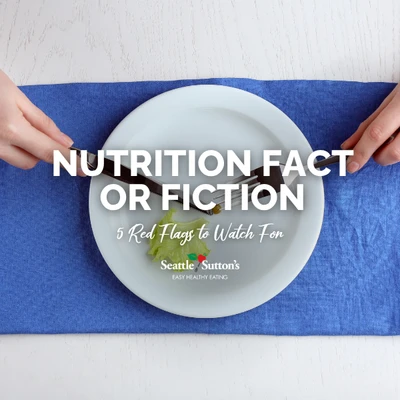
Red Flag #1: They're Selling the Solution
Many social media personalities make their living by selling supplements, meal plans, powders, or coaching programs. While there's nothing inherently wrong with selling products, be cautious when nutrition advice exists primarily to convince you to buy something.
Sometimes these "nutrition experts" often receive training directly (and only) from the company whose products they're promoting, making their advice more of a sales pitch than an evidence-based recommendation.
Registered dietitians are trained to evaluate the entire body of nutrition research, not just the studies that support a product. Before spending your money, ask yourself: Is this advice backed by science, or is it backed by sales?
Red Flag #2: They Promise Quick Fixes or Miracle Cures
If someone claims one food, supplement, or eating pattern can "melt fat," "heal your gut," "boost your metabolism," or "cure inflammation," proceed with caution. Nutrition rarely works that way.
Many trendy products have little scientific evidence to support their claims. Some supplements can even interfere with medications, cause unwanted side effects, or provide far more of certain nutrients than your body actually needs. Sustainable health comes from consistent habits, not miracle products. Remember: if it sounds too good to be true, it probably is.

Red Flag #3: They Make You Feel Bad About Yourself
Nutrition advice should motivate you, not shame you. Be wary of accounts that label foods as "good" or "bad," suggest you must eat perfectly, or make you feel guilty for enjoying birthday cake, pizza night, or your favorite family recipes.
Everyone's body, medical history, lifestyle, budget, and goals are different. A plan that works for one person may not work for another. If an account leaves you feeling anxious, defeated, or like your worth depends on the number on the scale, it's probably doing more harm than good.
At Seattle Sutton's Healthy Eating, we believe healthy eating should fit into your life, not take it over. Progress, flexibility, and balance are far more sustainable than perfection.
Red Flag #4: They're Always Chasing the Next Diet Trend
Remember when celery juice was everywhere? Or butter coffee? Or carnivore? Or detox teas? Diet trends come and go, but good nutrition doesn't change nearly as often as social media makes it seem.
While nutrition science continues to evolve, the fundamentals of a well-balanced diet have remained remarkably consistent for decades:
- Eat plenty of fruits and vegetables.
- Include whole grains, lean proteins, and healthy fats.
- Enjoy a variety of foods.
- Focus on long-term habits rather than short-term restrictions.
At Seattle Sutton's Healthy Eating, our meals are designed by registered dietitians using these proven principles, not what's popular or trending. Every meal is built to provide balanced nutrition, helping you nourish your body without the stress of planning, counting, or following restrictive rules.
Red Flag #5: They Rely on Fear Instead of Facts
Many influencers build large audiences by making people afraid of everyday foods. You'll hear claims that ingredients are "toxic," carbohydrates are the enemy, or certain foods are "poison." These fear-based messages often cherry-pick research or take studies out of context to generate clicks and shares.
Fear may grab attention, but it rarely leads to healthier habits. Instead, look for professionals who explain nutrition with context, acknowledge that healthy eating isn't all-or-nothing, and encourage balanced, realistic choices.
Choose Evidence Over Hype
Social media and the internet can be great places to discover healthy recipes, cooking inspiration, and practical wellness tips... but it can also spread misinformation faster than facts.
The next time a nutrition trend pops up in your feed, ask yourself:
- Is this advice supported by qualified experts?
- Does it sound realistic and sustainable?
- Is someone trying to educate me or sell me something?
- Does this content leave me feeling informed or fearful?
Healthy eating shouldn't require extreme rules or expensive products. It starts with small, consistent choices that you can maintain for life. Because the best diet isn't the one that's trending: it's the one you can enjoy, sustain, and feel good about for years to come.

Start Your Healthy Journey Today!
Order Now
 Weight Loss
 Health & Wellness
 Diabetes
 Heart Health
 Motherhood & Family
 Dietary Restriction
 Other Health Conditions
 About SSHE
Learn More And Boost Your Well Being